|
NOTE: Please acknowledge the authorship of these
program notes by Jose Elizondo, the composer, if you use them for publicity
material, concert program notes, or any other publication. |
|
|
·
·
·
·
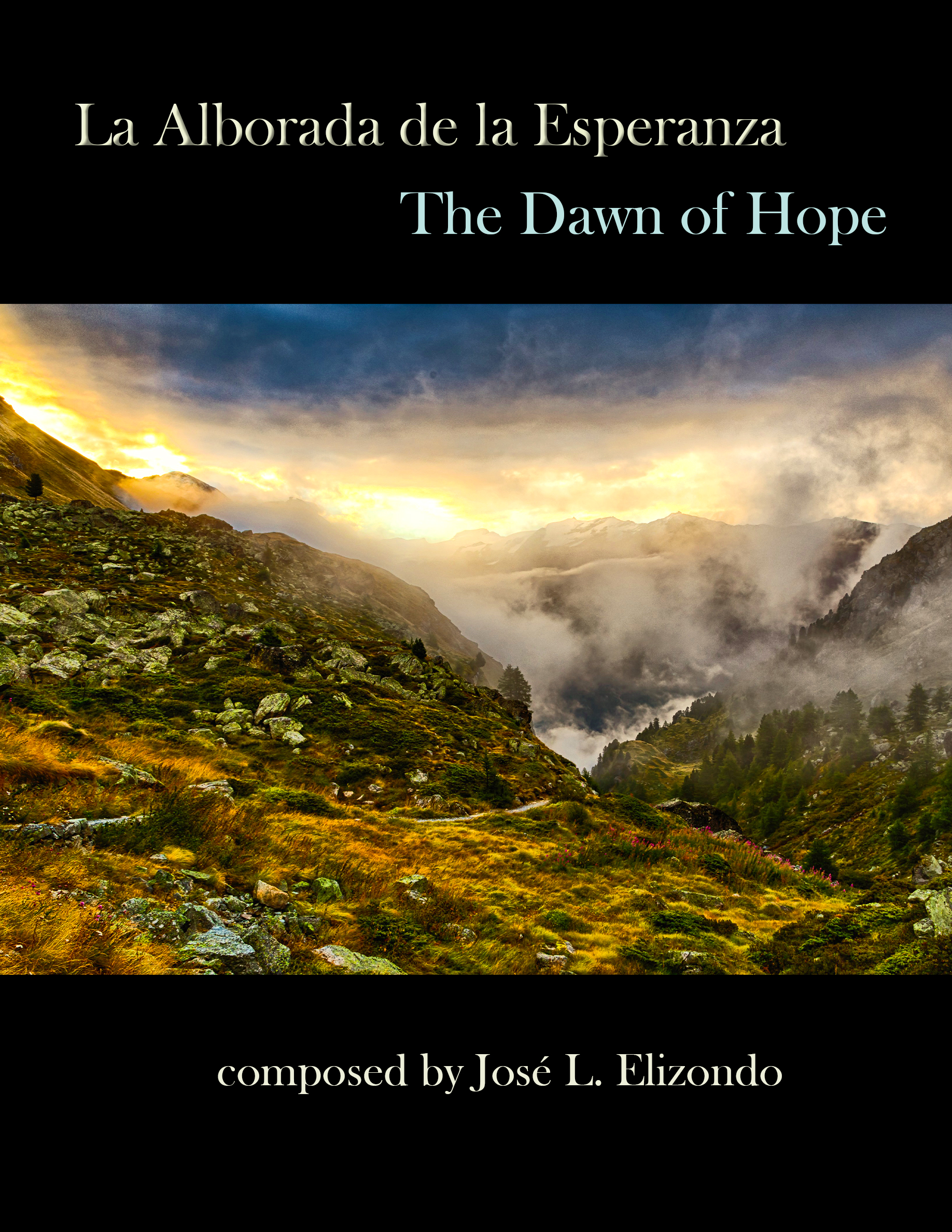
La
Alborada de la Esperanza
·
·
The Dawn of Hope
·
·
Die Morgendämmerung der Hoffnung
·
|
|
|
|
|
·
Commission: Commissioned by and
dedicated to French cellist Sébastien Hurtaud ·
Duration: 4 minutes ·
Mood: contemplative,
lyrical |
|
|
·
Description: The Dawn of Hope is a composition about the journey from
darkness to light. Just as the light of the rising sun dissipates the
darkness of the night, and fills us with the promise of a bright and
beautiful new day, hope and compassion give light to life's challenges and
remind us that we can overcome adversity and focuses on the hope of a better
future. ·
Premiere: The piano and
cello version was premiered by Sébastien Hurtaud and
Pamela Hurtado as part of the celebrations of the 100th anniversary of the
end of World War I on November 11th, 2018. The version for cello and string
orchestra was premiered during the World Youth Days in Panama on January
24th, 2019. |
|
|
|
|
|
Program Notes by José Elizondo: In 2018,
José Elizondo was commissioned by French cellist Sébastien Hurtaud to write a piece for two significant events: a
concert in Paris to commemorate the 100th anniversary of the Armistice that
marked the end of World War I (November 11th, 2018), and a concert in Panama
during the World Youth Days (January 24th, 2019). Shortly after receiving the
commission, a family member of the composer passed away, adding an unexpected
and deeply personal dimension to the piece. In the
words of the composer, "La
Alborada de la Esperanza is a composition about the journey from darkness to
light. Just as the light of the rising sun dissipates the darkness of the
night and fills us with the promise of a bright and beautiful new day, hope
and compassion give light to life's challenges and remind us that we can
overcome adversity.” An
additional source of inspiration for this piece was a poem by Australian
World War I veteran H. W. Pryce, who wrote about the moment in the trenches
when he was informed that the war was over. The phrase "The echoes die, the smoke-clouds thin and
pass..." inspired the composer to write
an ethereal introduction, like a cloud of smoke through which we perceive the
faint rays of the sun. This introduction gives way to the opening melodic
statement that evokes the sunrise. The choice of the musical key of G serves
a symbolic function, as “G” is “sol” in Spanish, which also means “sun.” The
composer wanted to link this piece to Bach, one of his most important sources
of inspiration, by having the first notes of the opening theme in the cello
echo the first five notes of Bach’s Prelude from the first Cello Suite. The
ascending character of this melodic gesture in G major further emphasizes the
imagery of the sun rising at dawn. After the initial
statement, which signals the positive and hopeful nature of the piece, the
instruments present a lament in a minor mode, embracing the listener with
empathy to acknowledge the pain of mourning. The viola has a particularly
poignant descending motive, almost as if it is crying along with the
listener. Meanwhile, the piano subtly references the Gregorian chant “Dies
Irae” in the top note of the chords that accompany the viola, as a reverent
gesture of remembrance for the dead. The piece
then undergoes a transformation from minor to major. Both instruments embrace
the “hope theme,” a warm, open, and luminous melody. The sun has fully risen,
covering everything with its light and warmth, just as the music attempts to
embrace the listener with the melody of hope. This piece is meant to be a
musical hug of consolation, an attempt by the composer to share a moment of
hope and empathy with the listeners. |
|
|
|
|